
Table of Contents
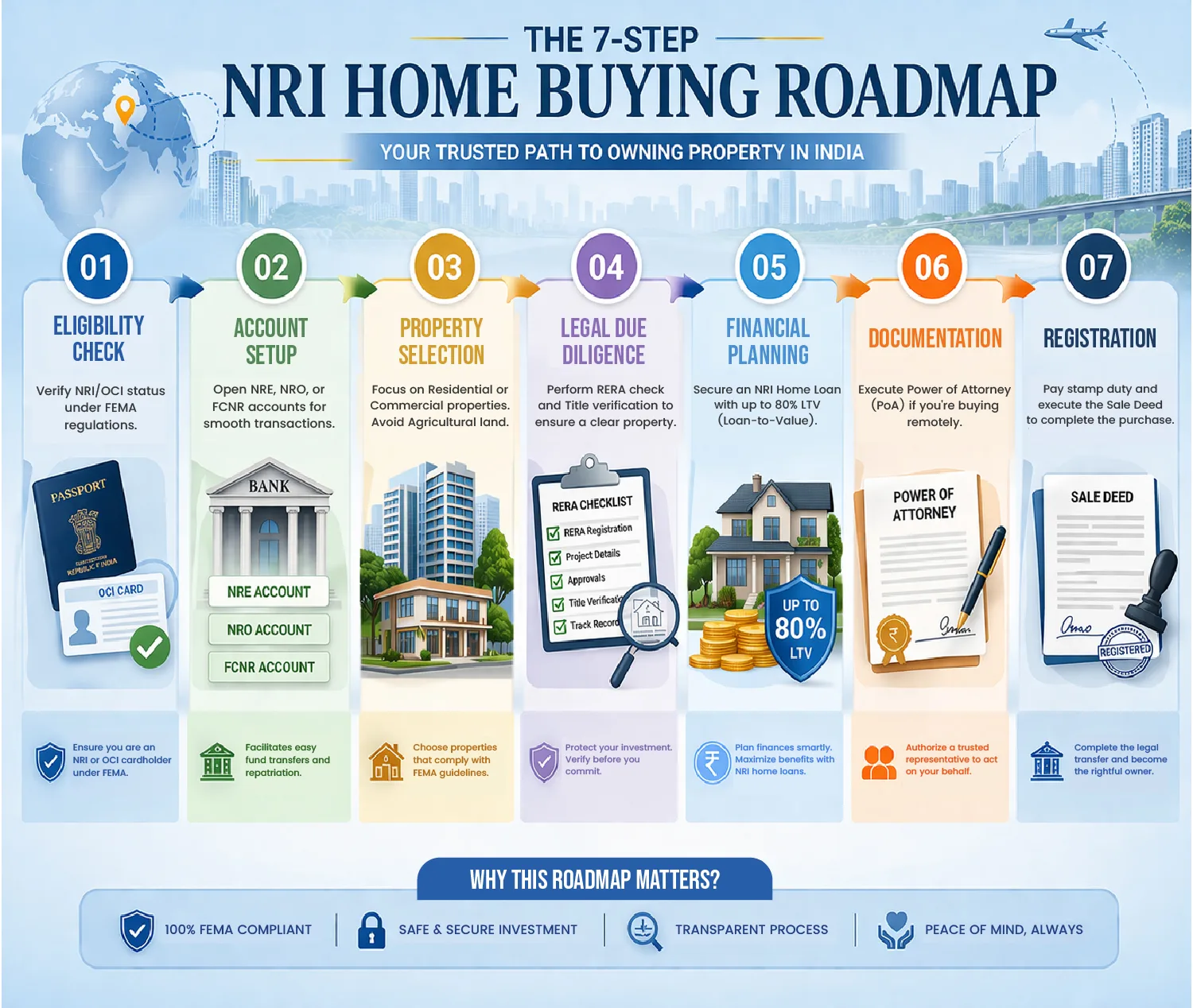
The Definitive 2026 Guide to the NRI Property Buying Process in India
For a NRI, owning a piece of the homeland is a journey that balances high-yield financial goals with a deep emotional connection to one’s roots. As we move through 2026, the Indian real estate sector—especially in hyper-growth cities like Pune—has transformed into a transparent, tech-driven, and highly regulated market. However, the NRI property buying process in India still requires a meticulous understanding of foreign exchange laws, tax implications, and local market trends to ensure a smooth and secure transaction.
At NOW REALTY, we recognize that our global clients demand "timeless spaces" that offer international standards of living, robust capital appreciation, and absolute legal peace of mind. Whether you are eyeing ready to move 3 BHK flats in Pune for your parents or looking for a long-term wealth creation vehicle, this comprehensive 2,500-word guide breaks down every facet of the NRI investment journey in 2026.
Understanding Your Legal Standing: FEMA, RBI, and Eligibility
The foundation of the NRI property buying process in India is governed by the Foreign Exchange Management Act (FEMA) and regulated by the Reserve Bank of India (RBI). In 2026, these rules are more streamlined than ever, yet they remain strict regarding the types of property an NRI can own.
Defining Your Status: NRI vs. OCI
Before starting your property search, it is vital to confirm your status under Indian law:
- NRI (Non-Resident Indian): An Indian citizen residing outside India for more than 182 days in a financial year for employment, business, or any other purpose indicating an indefinite stay.
- OCI (Overseas Citizen of India): A foreign citizen of Indian origin who is registered as an OCI cardholder. Under current laws, OCIs enjoy almost the same property-buying rights as NRIs.
Permissible and Prohibited Properties
NRIs and OCIs have broad freedom to invest, but there are specific red lines:
- Residential Properties: You can buy any number of flats, villas, or bungalows.
- Commercial Properties: Office spaces, retail shops, and warehouses are fully permissible.
- Prohibited Assets: NRIs are strictly forbidden from purchasing agricultural land, plantation property, or farmhouses. These assets can only be acquired through a registered inheritance.
If you are looking for a secure investment without the legal hurdles of land classification, exploring property in Baner Pune is the most reliable route for global investors in 2026.
Financial Framework: Managing Funds and Bank Accounts
One of the most critical aspects of the NRI property buying process in India is how you manage your money. You cannot use foreign currency or direct overseas transfers to pay a seller in India; all transactions must pass through designated Indian bank accounts.
NRE vs. NRO Accounts: The 2026 Liquidity Guide
Understanding the distinction between these accounts is vital for your future liquidity and tax planning.
- NRE (Non-Resident External) Account: This account holds funds remitted from abroad. The principal and interest are fully and freely repatriable, meaning you can move the money back to your country of residence without any RBI limit.
- NRO (Non-Resident Ordinary) Account: This account manages income earned in India, such as rent, dividends, or pension. While interest is repatriable, the principal repatriation is capped at USD 1 million per financial year after payment of applicable taxes.
- FCNR (Foreign Currency Non-Resident) Account: Best for maintaining your savings in foreign currency (like USD or GBP) to avoid exchange rate fluctuations. Funds are completely repatriable upon maturity of the fixed deposit.
2026 Payment Compliance
Under current RBI guidelines, payments for property must be made using funds remitted from abroad via normal banking channels or funds held in your NRE/NRO/FCNR accounts. Payments via traveler’s cheques or foreign currency notes are strictly prohibited and can lead to severe FEMA penalties.
Step-by-Step Breakdown of the Purchase Process
Navigating a high-value transaction from a different time zone requires a structured and disciplined approach. Here is how the purchase journey unfolds in 2026.
Property Selection and RERA Verification
In 2026, the first rule of any real estate investment is RERA (Real Estate Regulatory Authority) compliance. Every project must have a valid RERA number. If you are exploring new projects in Pune, always verify the registration on the MahaRERA portal. This ensures the developer is legally bound to the promised specifications, carpet area, and completion timeline.
Property Selection and RERA Verification
Distance should never mean a compromise on due diligence. In 2026, we recommend verifying:
- Title Search: A title report for the last 30 years to ensure the property is free from encumbrances, litigation, or previous undisclosed sales.
- NOCs and Approvals: Ensure No Objection Certificates from the local municipal corporation, water authority, and electricity board are in place.
- Occupation Certificate (OC): For ready-to-move-in properties, the OC is mandatory as it proves the building is fit for habitation and complies with all sanctioned plans.
The Power of Attorney (PoA): Managing Signatures Remotely
If you cannot be physically present for the registration, you can appoint a trusted representative in India via a Specific Power of Attorney.
- Execution: Sign the PoA in the presence of a Consulate Officer or a registered Notary in your country of residence.
- Adjudication: Once the document reaches India, it must be adjudicated (stamped) at the local registrar's office within three months to become a legally valid instrument for property registration.
NRI Home Loans: Financing Your Dream in 2026
Indian banks have simplified the real estate in Pune financing model for global citizens. In 2026, securing an NRI home loan is a predominantly digital process.
Eligibility, LTV, and Documentation
Banks typically finance up to 75% to 80% of the property value for NRI borrowers. To apply in 2026, you will generally need:
- Valid Passport and Visa/OCI Card.
- PAN Card (Mandatory for all Indian property transactions).
- Last 6 months’ overseas bank statements showing salary credits.
- Latest 3 months’ salary slips and a valid employment contract.
- Credit report from your country of residence (e.g., Experian or Equifax).
Repayment and Interest Rates
The loan must be repaid in Indian Rupees (INR). You can use funds from your NRE/NRO accounts or even use the rental income generated from the property. In 2026, NRI home loan interest rates remain competitive, with many luxury flats in Pune commanding enough rent to cover a significant portion of the EMI, making the investment self-sustaining.
Tax Implications: Rental Income and Capital Gains
Taxation is the area where NRIs often feel the most confusion. However, the 2026 tax framework has been streamlined to provide clarity for global investors.
Tax on Rental Income
If you lease your property, the rent is considered income earned in India and is taxable accordingly.
- TDS on Rent: Under Section 195, the tenant must deduct 31.2% TDS (including cess) on the rent paid to an NRI and deposit it with the government.
- Standard Deduction: You can claim a flat 30% deduction on the rental income for repairs and maintenance, regardless of your actual expenditure.
Capital Gains Tax (LTCG vs. STCG)
When you decide to sell your property, the taxation depends on the holding period:
- Short-Term Capital Gains (STCG): If the property is sold within 24 months, gains are taxed as per your individual income tax slab.
- Long-Term Capital Gains (LTCG): If held for more than 24 months, the tax rate is a flat 12.5% (as per the simplified 2026 regime for properties acquired after July 2024).
Major 2026 Reform: Removal of TAN Requirement
A significant reform in Budget 2026 has removed a major administrative hurdle. Resident buyers purchasing property from NRIs no longer need a Tax Deduction Account Number (TAN). They can now deduct and deposit TDS using their PAN alone, aligning the process with resident-to-resident transactions. This reform has drastically speeded up property registrations and reduced compliance friction for NRI sellers.
Why Pune is the Top Choice for NRI Investment in 2026
Pune has consistently outperformed other Tier-1 cities in terms of "livability" and "rental yield." When looking for the best location in Pune to buy a flat, the Western corridor remains the most preferred for global citizens.
The Baner-Balewadi Tech Synergy
The Baner Balewadi region has evolved into a global lifestyle hub. With the Pune Metro Line 3 nearing full operation in 2026, the commute to the Hinjewadi IT Park has been reduced to minutes, significantly boosting rental demand.
- Rental Yields: Current yields in Baner hover between 3.5% and 5.5%, among the highest for residential real estate in India.
- Capital Appreciation: The infrastructure boom, combined with the presence of top-tier schools and hospitals, has led to a consistent 10-15% annual rise in property values.
Space Trends: The Rise of 3 BHK and 4 BHK Units
Post-pandemic, the demand for larger living spaces has become permanent. Current trends show that families are prioritizing "Work-from-Home" dens and guest rooms. For an NRI, investing in larger configurations like 3 BHK or 4 BHK units offers better liquidity and attracts premium corporate tenants compared to smaller apartments.
Managing Your Investment Remotely: 2026 Trends
The biggest fear for any NRI owner is the lack of physical presence to monitor their asset. In 2026, professional Property Management Services (PMS) have filled this gap.
- Tenant Vetting: Digital background checks and police verification are now standard procedures.
- Proactive Maintenance: Managers use IoT sensors and mobile apps to provide owners with real-time updates on property condition and repair needs.
- Legal Compliance: PMS providers handle the drafting of registered Leave and License agreements and ensure all local taxes (like Property Tax) are paid on time.
Repatriation of Sale Proceeds: Taking Your Money Back
A common question in the NRI property buying process in India is: "Can I legally take my money back?"
Baner: The Modern Powerhouse
Baner continues to be the crown jewel of the Western corridor. Its proximity to the now-operational Metro Line 3 and the Hinjewadi-Balewadi sports cluster has made it the top choice for IT executives. If you are researching where is Baner in Pune, you will find it at the intersection of Pune's business future and its greenest hills.
- Principal Repatriation: If the property was bought using NRE funds or foreign remittance, you can repatriate the principal amount for up to two residential properties without any limit.
- Profit Repatriation: Profits from the sale, or proceeds from properties bought using NRO funds, can be repatriated within the USD 1 million annual limit.
- Documentation: You will require Form 15CA (remitter's declaration) and Form 15CB (a certificate from a Chartered Accountant) to ensure all Indian taxes have been settled before the bank converts and remits the funds.
Frequently Asked Questions for NRIs in 2026
Securing Your Legacy with NOW REALTY
The NRI property buying process in India is no longer the maze of paperwork it once was. With the 2026 regulatory framework, the removal of administrative bottlenecks like the TAN requirement, and the rise of digital transparency, the Indian market is a beacon for global wealth.
At NOW REALTY, we don't just build apartments; we build assets that stand the test of time. From our property in Baner Pune to our premium upcoming landmarks, we provide the transparency, architectural excellence, and after-sales support that NRIs expect. Whether you are seeking a home for your eventual return or a high-performing financial asset, the Indian growth story is waiting for you.